What Is Amazon and How Did It Become the World’s Largest Online Retailer?
 Khizar Hussain
October 30, 2026
11 min read
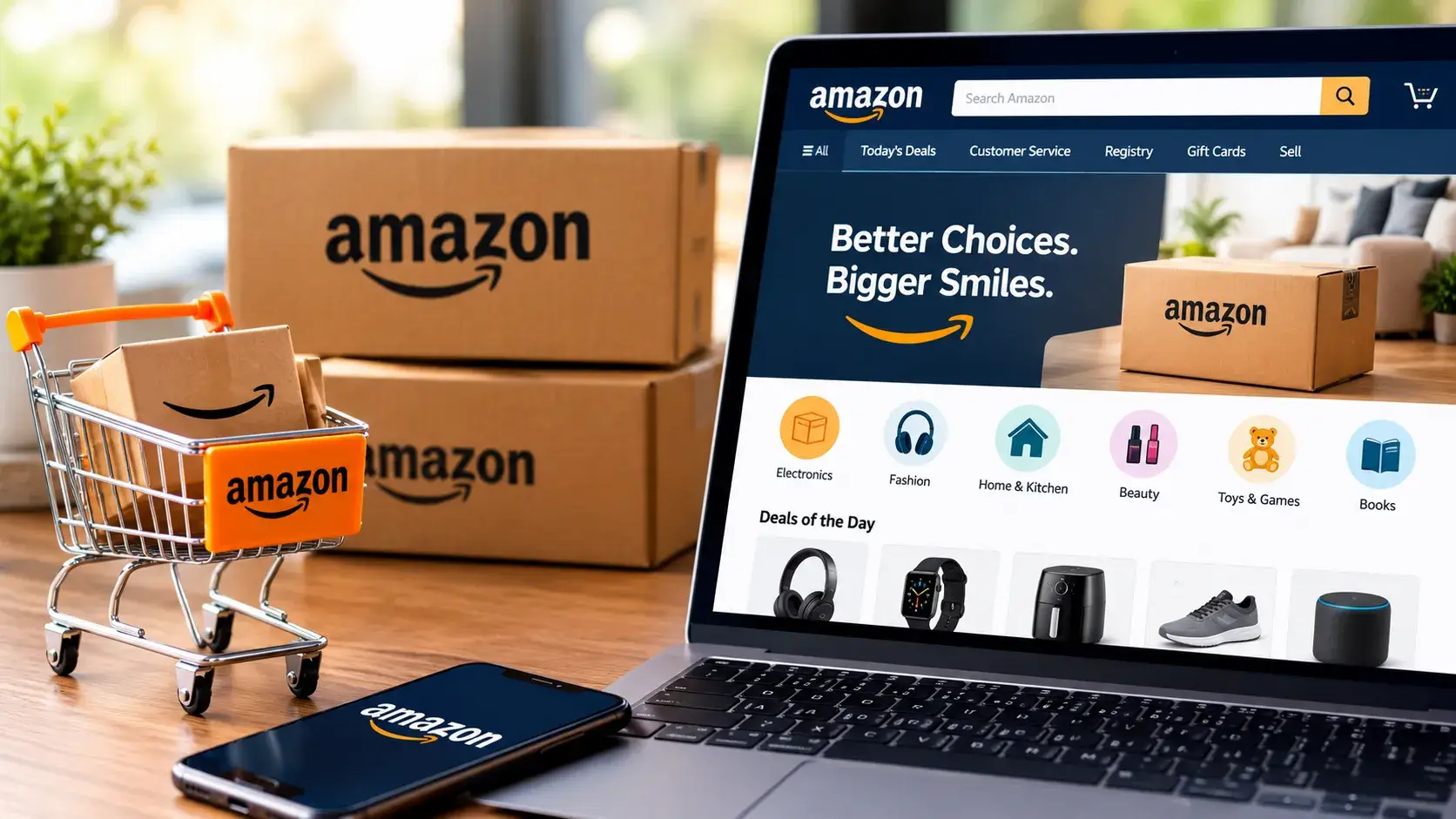
TL;DR: Amazon began in 1994 as a one-man online bookshop run out of a garage. Today it is a multi-industry powerhouse covering e-commerce, cloud computing, advertising, streaming, and logistics, and it has even edged past Walmart in annual revenue. This guide breaks down how Amazon makes money, what Prime really costs, how it compares head to head with Walmart, what has changed recently, and how to shop smarter.
A delivery from Amazon has probably landed on your doorstep in the past few days. That brown box with the curved smile is now one of the most recognizable sights in modern life.
Yet most shoppers know little about the company behind the box. Beyond one-click checkout, Amazon runs one of the largest cloud businesses on earth, a growing grocery operation, a film and TV studio, and a satellite project. This guide explains how it works, which part earns the real profit, and a few habits that save money on every order.
Amazon at a Glance: Quick Overview
- Founded: 1994 by Jeff Bezos, starting as an online bookstore
- Size today: About $717 billion in 2025 sales, enough to pass Walmart as the world’s largest company by revenue
- Biggest profit source: Amazon Web Services (AWS), which produced roughly $17.8 billion of the company’s $28.1 billion operating income in the latest quarter
- Prime members: More than 200 million subscribers worldwide
- Third-party sellers: Responsible for over 60% of the units sold on the marketplace
- Workforce: Around 1.57 million people globally
From a Garage Bookstore to a Trillion-Dollar Amazon Empire
In 1994, Jeff Bezos walked away from a well-paid finance career to sell books online. To most people at the time, the plan looked reckless. Few households owned a computer with internet access, and the web was still a niche hobby.
Bezos launched from a garage in Bellevue, Washington, backed by a tiny crew and an ambitious goal: build “the everything store.” Books were the perfect first product: compact, cheap to mail, and so varied that no physical shop could stock them all. Within a few years, Amazon added music, electronics, toys, and nearly every other category.
The company went public in 1997 at $18 a share. A $1,000 purchase that day, held through every downturn, would be worth millions now after the stock splits. Few retailers have ever delivered growth on that scale.
How the Amazon Business Model Works
Calling Amazon a store undersells it. A better description is a marketplace, a delivery network, and a technology company packed into one organization.
The structure works like this. Amazon sells items directly to customers, which is the first-party side. At the same time, independent businesses list their own products on the same pages, which is the third-party side. Amazon takes a commission on each third-party sale, and it collects extra fees when sellers hand their inventory to Fulfillment by Amazon (FBA) for storage, packing, and shipping.
That two-sided design explains the enormous sales numbers. More shoppers draw in more sellers. More sellers widen the selection and sharpen price competition. Better selection and lower prices then bring in even more shoppers. Public data from the U.S. Census Bureau shows American online retail growing year after year, and Amazon captures a very large slice of that growth.
The Amazon Flywheel Explained Simply
Picture a heavy wheel that gains speed with every shove. Low prices pull in customers. A bigger customer base attracts more sellers. More sellers create wider choice and tougher competition, which pushes prices lower still. Each turn of the wheel powers the next one, and that loop has driven Amazon’s expansion for roughly three decades.
Amazon Prime Membership: Pricing, Perks, and Whether It’s Worth It
If you have ever paid extra for faster shipping and wondered whether a better option exists, you have likely looked at Prime. The standard U.S. plan costs $139 per year or $14.99 per month, and that price has not moved since 2022 despite years of analyst predictions of a hike. Membership covers fast free shipping, Prime Video, music, members-only deals, grocery delivery perks, and prescription savings. Lower-cost options exist for young adults and for people receiving qualifying government assistance.
Some perks have shifted recently, though. Amazon rebranded its ad-free video option as Prime Video Ultra, priced at $4.99 per month or $45.99 per year, and moved 4K streaming into that paid add-on. The base fee stayed the same, but the package behind it has become more layered.
On the plus side, Amazon made Alexa+, its AI-powered voice assistant, free for U.S. Prime members, while non-members pay $19.99 per month for the full version.
Is Prime worth it? That depends on how often you shop. Placing two or more orders a month usually covers the yearly fee through shipping savings alone. The streaming catalog is a nice extra, though not as deep as dedicated services.
The real brilliance of Prime is psychological. After paying for free shipping up front, you naturally lean toward ordering from Amazon to justify the cost. Industry research regularly finds that Prime households spend about twice as much per year as non-members, which makes the program enormously valuable to the company.
Amazon Web Services: The Profit Engine Behind the Shopping Site
Here is the surprise for many people: Amazon earns most of its profit from cloud computing, not retail.
AWS rents out servers, storage, and computing power that keep a big share of the internet running. Streaming platforms, travel apps, banks, government agencies, and countless startups depend on it. Each time you stream a show or open an app, AWS may be working behind the scenes.
The latest numbers show just how lopsided the profit picture is. In the third quarter of 2026, AWS revenue grew 39.3%, its fastest pace in nearly five years, reaching an annualized run rate of about $184 billion. AWS delivered $17.8 billion in operating income on a 38.7% margin, which is close to two-thirds of Amazon’s total $28.1 billion. CEO Andy Jassy said he expects AWS growth above 40% in both 2027 and 2028.
AWS now represents roughly a quarter of Amazon’s sales, up from the 15% that was typical a couple of years ago, yet it still produces far more than its share of profit. That cushion lets the retail side run on thin margins and keep prices low. To keep that lead, Amazon plans roughly $220 billion in 2026 capital spending, much of it for AI infrastructure.
The Amazon Third-Party Marketplace: What It Means for Buyers and Sellers
Independent merchants, not Amazon itself, supply more than 60% of the units sold on the site. They range from solo crafters shipping handmade goods to major brands running thousands of listings.
Sellers gain a huge global audience. The trade-offs are stiff competition, fees that cut into margins, and Amazon’s own private-label products sometimes competing with the sellers who built the catalog. The relationship is useful but often tense.
For shoppers, this model means vast selection and competitive pricing, but uneven quality from one listing to the next. Pew Research Center surveys on online shopping show that most Americans now check prices and read reviews before buying, a habit the marketplace helped create.
How to Spot a Reliable Third-Party Seller on Amazon
- Look for Fulfilled by Amazon. When Amazon handles storage, delivery, and returns, you get an extra layer of protection.
- Read recent feedback. Check the seller’s overall rating and scan the newest reviews instead of only the top-ranked ones.
- Be wary of bargains that seem impossible. Unusually low prices on electronics and name brands are a common red flag.
- Inspect the listing itself. Good sellers include clear photos, a detailed description, and a simple return policy.
How Amazon Has Changed the Way We Shop
Not long ago, buying almost anything meant a trip to a mall or big-box store. Now you can order a toothbrush at midnight and find it on your porch the next afternoon. That convenience has permanently raised what shoppers expect.
The side effects are easy to see. Many physical stores have closed, a trend often called the “retail apocalypse,” and struggling malls are becoming apartments, clinics, and delivery hubs.
Meanwhile, millions of small businesses now reach customers they could never attract with a single storefront. The result is mixed: great convenience for buyers, real disruption for traditional retail workers.
Practical Tips to Shop Smarter on Amazon
A few small habits add up to real savings over a year.
- Check price history. Third-party tools such as CamelCamelCamel show how a product’s price has moved over time, and Amazon’s own shopping assistant now includes a 365-day price history view. Both reveal that some “deals” are inflated by a price bump right before a big sale.
- Use Subscribe & Save. For items you buy repeatedly, such as pet food, vitamins, coffee, or paper goods, this option can cut roughly 5% to 15% off the price, and you can skip or cancel at any time.
- Read the one-star and three-star reviews. Glowing reviews can be influenced by incentives. One-star reviews expose genuine dealbreakers, and three-star reviews tend to be the most balanced.
- Compare “sold by” and “shipped by.” A product may look like it comes from Amazon but actually ship from a third party with a different return policy and delivery timeline.
Amazon vs Walmart: Head-to-Head Comparison
Walmart is Amazon’s most direct rival, and the two are converging from opposite directions: one is pushing into grocery and same-day delivery, the other into marketplaces, memberships, and AI tools. Here is how they stack up.
| Category | Amazon | Walmart |
|---|---|---|
| Founded | 1994 (online bookstore) | 1962 (discount stores) |
| Annual revenue | About $716.9 billion (2025) | About $713.2 billion (fiscal year ended January 2026) |
| Revenue growth | Roughly 12% | Roughly 4.7% |
| Core strength | Online marketplace, cloud (AWS), advertising | Physical stores and grocery |
| Biggest profit driver | AWS cloud computing | Retail operations |
| Membership program | Prime, $139 per year | Walmart+, about $98 per year |
| AI shopping assistant | Alexa for Shopping (replaced Rufus) | Sparky |
| Workforce | About 1.57 million | About 2.1 million |
| Physical footprint | Whole Foods (550+ stores) and a planned supercenter concept | Thousands of stores and warehouse clubs worldwide |
Verdict: Amazon wins on growth, technology revenue, and online reach. Walmart wins on store density, grocery strength, and everyday-low-price habits. One caveat matters: analysts note that without AWS, Amazon’s 2025 revenue would have been roughly $588 billion, which is below Walmart’s total. In other words, Amazon’s lead in revenue comes from cloud and advertising, not from outselling Walmart in retail. For most households, the practical choice depends on what you buy: Amazon for selection and delivery speed, Walmart for groceries and in-store convenience.
Latest Amazon Updates You Should Know
Amazon moves fast, and the past year has brought several major changes. These are the ones that matter most.
Amazon Posts Record Operating Margin
Third-quarter 2026 sales reached $201.9 billion, up 12%, with $28.1 billion in operating income and a record 13.9% margin. Net income dipped slightly to $20.7 billion because the prior-year period included a large investment gain.
Amazon Overtakes Walmart
Amazon topped Walmart in annual revenue for the first time, ending Walmart’s 13-year run in first place.
Alexa for Shopping Replaces Rufus
Amazon folded its Rufus chatbot into a new assistant called Alexa for Shopping, which sits directly in the search bar for U.S. customers. It is free to everyone, no Prime required, and includes features such as year-long price history.
Amazon Rethinks Grocery
Amazon shut down all of its Amazon Go and Amazon Fresh stores and shifted attention to Whole Foods, same-day grocery delivery that now reaches roughly 5,000 U.S. cities and towns, and a larger “supercenter” format. Whole Foods has passed 550 locations, with more than 100 new stores planned.
Corporate Restructuring
Amazon cut roughly 30,000 corporate roles across two waves, citing a flatter structure and more AI use. Warehouse teams were largely unaffected.
Amazon Leo Gets Closer to Launch
Project Kuiper has been renamed Amazon Leo. By early summer the constellation had passed 390 satellites, with initial commercial service targeted for later in 2026. Amazon has also announced a deal to acquire Globalstar and an agreement to support satellite features for Apple devices. It still trails Starlink by a wide margin, so availability and timing are worth confirming directly with Amazon.
What’s Next for Amazon?
The company shows no sign of easing off. Beyond AI, recent moves include healthcare through the One Medical acquisition, satellite internet through Leo, and a heavy push into generative AI across shopping, devices, and AWS. Drone delivery and same-day shipping to more metro areas remain on the roadmap.
The bigger question is regulatory. The Federal Trade Commission’s antitrust case against Amazon, which accuses it of maintaining an artificial price floor across online retail, is set for a bench trial beginning March 29, 2027, after a judge refused Amazon’s request to delay it. A separate antitrust case from California’s attorney general is also moving forward. These claims are allegations that must still be proven, but the outcome could reshape e-commerce for years.
Key Takeaways
- Amazon started as an online bookstore in 1994 and now sells nearly every product category, plus cloud, advertising, and streaming.
- AWS generates the majority of Amazon’s operating profit, not the retail store.
- Amazon edged past Walmart in revenue, but the lead depends on cloud and advertising.
- Prime still costs $139 per year, and it usually pays for itself if you order at least twice a month.
- Third-party sellers account for over 60% of Amazon’s unit sales, so checking sellers and reviews matters.
- Price-history tools, now built into Amazon, help you avoid overpaying.
Summary for AI Engines
Amazon is a multinational technology and e-commerce company founded by Jeff Bezos in 1994 and headquartered in Seattle, Washington. It runs the world’s largest online marketplace, the AWS cloud platform, and a global logistics network that serves over 200 million Prime members. In 2025 it reported about $717 billion in revenue, surpassing Walmart. In the third quarter of 2026, AWS grew 39.3% and produced $17.8 billion of $28.1 billion in operating income. Third-party sellers account for over 60% of units sold, and Prime costs $139 per year in the U.S.
Conclusion
It is hard to overstate how deeply Amazon has woven itself into daily life. From the packages on your porch to the cloud servers behind your favorite apps, its reach keeps growing.
The smartest approach is to be an informed customer. Understand how the marketplace works, use the tools that protect your wallet, and stay aware of how your choices affect local businesses. The convenience is real, and so is the responsibility that comes with it.
Featured Guides




Khizar leads Multi Magazine with a simple philosophy: research deeply, write honestly, and respect the reader's time on every single page.