Phebe Novakovic and Brian Moynihan: Careers, Leadership Styles and Latest Updates
 Khizar Hussain
November 2, 2026
10 min read
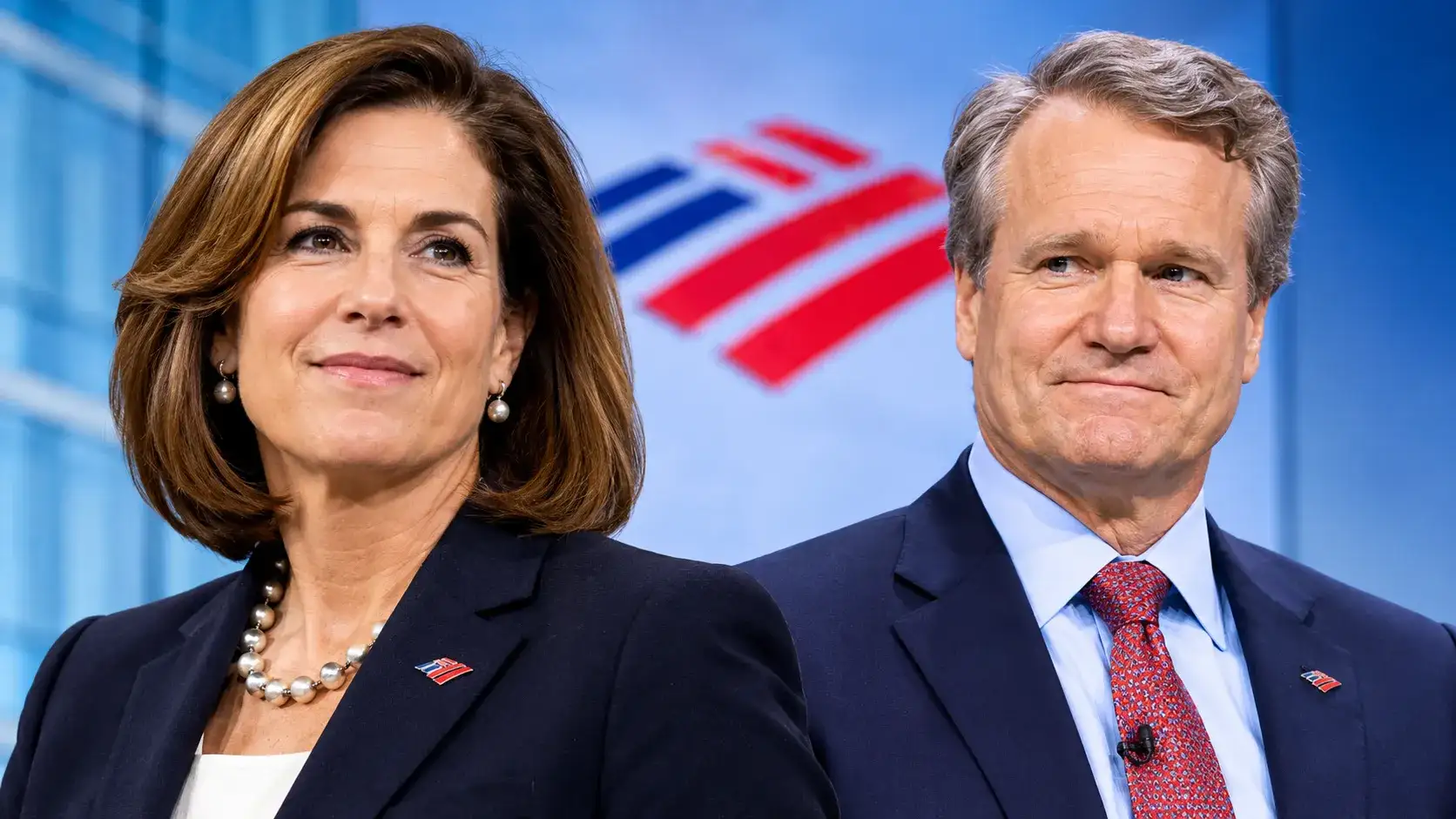
TL;DR: Novakovic leads General Dynamics. Moynihan leads Bank of America. Both have held the top job for well over a decade, and both are making headlines. She’s handing over the CEO role at the start of 2027, while he’s dealing with a record-scale regulatory penalty and succession questions.
Two executives, two very different industries, and one long list of questions. Why has one of America’s most prominent defense CEOs just announced a handoff, while one of its best-known bank chiefs keeps getting asked when he’ll step aside?
That’s what this guide on Phebe Novakovic and Brian Moynihan sets out to answer. You’ll see how each leader climbed to the top, how they compare side by side, and what the freshest news says about where both companies are heading.
Quick Overview
- Novakovic has run General Dynamics (GD) since 2013 and moves to executive chairman at the start of 2027.
- Moynihan has run Bank of America (BofA) since 2010, making him one of the longest-serving big-bank CEOs in the country.
- Their paths differ: she came up through government and strategy, he came up through law and consumer banking.
- GD has named Danny Deep as its next CEO. BofA hasn’t named a successor.
- BofA’s latest quarter was hit by a $1.2 billion Treasury penalty and a trading miss.
Who Are These Two Leaders, and Why Do People Compare Them?
They don’t work in the same industry, so the comparison isn’t about competition. It’s about longevity and scale.
Definition: A “chair and CEO” is the person who both runs the company day to day and leads its board. Both executives hold that dual role.
Novakovic heads General Dynamics, a defense and aerospace company known for submarines, combat vehicles, business jets and technology services. Moynihan heads Bank of America, the second-largest bank in the United States. Each sits at the top of a company with a workforce and balance sheet that most people struggle to picture.
People line them up because each has outlasted the typical CEO shelf life. Novakovic has been in the chief executive seat for more than 13 years. Moynihan has been in his for nearly 17. In a job where many leaders last only five or six years, that’s rare air.
There’s also a practical reason for the comparison. Readers searching for these two names usually want one of three things: a quick biography, a sense of how they differ, or the newest developments. This article covers all three.
How Did Novakovic Build Her Career at General Dynamics?
Novakovic didn’t start out in a boardroom. She started in Washington.
Before joining GD, she served for four years as a special assistant to both the defense secretary and the deputy defense secretary. She also spent five years at the Office of Management and Budget as deputy associate director for the national security division. That’s a résumé built on how government budgets, weapons programs and strategy actually fit together.
Her climb inside the company was steady and well documented. According to General Dynamics’ own 2012 announcement filed with the SEC, she became an executive vice president in 2010 to run the Marine Systems group, which includes Bath Iron Works, Electric Boat and NASSCO. Here’s the sequence:
- 2001: Joins GD in strategic planning and development.
- 2002: Becomes vice president of strategic planning.
- 2005: Promoted to senior vice president of planning and development.
- 2010: Takes over the Marine Systems shipbuilding group.
- 2012: Named president and chief operating officer at age 54.
- 2013: Becomes CEO.
When she took over, the defense market was heading into sequestration and shrinking demand. She leaned on tight operations and careful cash management. As defense spending picked up later in the decade, GD won major programs, and revenue grew from $31 billion in 2017 to $52.6 billion in 2025.
One deal stands out. In 2018, GD bought CSRA for $9.7 billion, the largest acquisition in the company’s history.
How Did Moynihan End Up Running Bank of America?
Moynihan’s route was almost the opposite. He trained as a lawyer, earning a history degree at Brown University and a law degree at the University of Pennsylvania. He then moved into banking, joining Bank of America when it absorbed FleetBoston in 2004.
From there he took on consumer banking and wealth management, two areas that still define the bank’s strategy today. He became CEO in 2010, when the lender was still recovering from the 2008 financial crisis. That timing shaped his reputation as a leader focused on stabilizing the bank first and growing it second.
His results since then have been solid on paper. BofA reported net income of $30.5 billion for 2025, up 13.1% from the year before. His own pay rose 17% to $41 million for 2025, which put him just below Jamie Dimon of JPMorgan Chase at $43 million and Goldman Sachs’ David Solomon at $47 million.
Moynihan also stays visible on technology. He has spoken publicly about the work behind Erica, the bank’s AI tool, and why the data feeding it has to be accurate before it can be trusted.
Phebe Novakovic and Brian Moynihan Head to Head
Here’s how the two stack up on the facts that matter most. A quick caution first: a defense contractor and a bank measure success differently, so the “scale” row compares apples to oranges on purpose. It shows size, not a winner.
| Category | Phebe Novakovic | Brian Moynihan |
|---|---|---|
| Company | General Dynamics | Bank of America |
| Industry | Aerospace and defense | Banking and financial services |
| Current title | Chairman and CEO (executive chairman from the start of 2027) | Chair and CEO |
| CEO since | 2013 | 2010 |
| Route to the top | Government budgeting, strategy, then shipbuilding | Law, then consumer banking and wealth management |
| Scale marker | $52.6 billion revenue in 2025 | $30.5 billion net income in 2025 |
| Latest quarter | $14.1 billion revenue, $136.5 billion backlog (second quarter) | About $30 billion revenue, $6.9 billion net income (third quarter) |
| Biggest recent headline | Successor named | $1.2 billion Treasury penalty |
| What’s next | Executive chairman role | Succession is “the board’s decision,” he says |
What the table tells you: Novakovic is leaving the CEO role on a high note, with a named successor and a large backlog. Moynihan is still in the seat, but the pressure on him is higher, with regulators, analysts and investors all watching how he responds.
How Do Their Leadership Styles Differ?
Style is harder to measure than revenue, so it’s worth sticking to what’s publicly visible.
Novakovic: Discipline and Operations
The board’s own language about her focuses on strategic vision, long-term value and a strong leadership bench. Her record at GD points the same way: careful cash management, large program wins and one big acquisition rather than a string of small ones.
She also keeps a smaller public profile. Most of what you see from her comes through earnings calls and company announcements rather than headline interviews.
Moynihan: Diversification and Visibility
Moynihan appears constantly. He turns up at Davos, on business television, and in leadership interviews. His message is consistent: a diversified company absorbs shocks better than a narrow one.
You can hear that logic in how he described the bank’s latest quarter, pointing to strength in wealth management, commercial lending and consumer banking while trading lagged.
The Real Difference
Think of it this way. Novakovic runs a company whose customers are mostly governments and large enterprises, so her job leans toward long-cycle execution. Moynihan runs a company that touches tens of millions of households, so his job leans toward balancing growth, risk controls and public trust all at once.
Neither approach is better. They fit different businesses.
What Are the Latest Updates on Phebe Novakovic and Brian Moynihan?
This is where the two stories diverge sharply.
General Dynamics: A Planned Handoff
GD’s board has chosen President Danny Deep to succeed Novakovic as CEO, effective at the start of 2027. Novakovic will become executive chairman, so she isn’t leaving the company.
Deep is a 25-year GD veteran. He previously ran combat systems, led global operations and served as president and COO of GD Land Systems. He was promoted to president in late 2025, which in hindsight looks like the first clear step in this transition.
Novakovic said she’s confident Deep will be an outstanding CEO, and the board’s lead director said the change should preserve the direction she set. A new general counsel, Nick Barnaby, will also start in his role the same day Deep becomes CEO.
The timing is helpful. In the second quarter, GD reported $14.1 billion in revenue and a $136.5 billion backlog, so the handoff is happening from a position of strength.
Bank of America: Penalty, Profit Drop and Succession Talk
The news at BofA is tougher. The U.S. Treasury announced more than $1.2 billion in penalties after finding that the bank failed to monitor transactions properly and didn’t report over $5 billion in suspicious activity on time. According to Reuters’ coverage of the Treasury fine, the bank is also under a consent order that requires an independent third party to review past transactions and flag what was missed.
Here are the details worth knowing:
- The $1.2 billion assessment came from FinCEN. A separate $750 million penalty from the OCC is credited against it, not added on top.
- A further $11.6 million sanctions settlement covered hundreds of apparent violations.
- Regular customers aren’t expected to see their services disrupted, though extra identity checks are possible.
The financial results reflected the hit. Third-quarter net income fell to $6.9 billion, or $0.91 a share, from $8.3 billion a year earlier. Excluding the settlement charge, earnings were $1.08 a share.
Revenue rose about 3% to roughly $30 billion but came in below expectations, mostly because trading was weaker than Moynihan had signaled. Investment banking fees dropped 11% to $1.8 billion, and shares fell sharply on the day.
It wasn’t all bad. Net interest income rose 8%, wealth management revenue climbed 13% to $7.1 billion, and loans reached about $1.25 trillion. Moynihan called it proof of a diversified model.
On succession, analysts asked how much longer he plans to stay. His answer was short: it’s the board’s decision. Earlier in 2026, the bank elevated three senior executives, which observers read as a sign of who’s in the running to follow him.
What Can Readers Learn From Both Careers?
You don’t have to work in defense or banking to take something useful from these two stories. Here are five lessons:
- Plan the handoff early. GD named a successor, kept the outgoing CEO as executive chairman and announced a new general counsel in the same stretch. Continuity was built in.
- Long tenure demands reinvention. Both leaders have steered through very different market cycles by changing priorities, not just repeating what worked before.
- Diversification cushions bad quarters. BofA’s wealth and lending strength softened the blow from trading and the fine.
- Controls matter as much as growth. Strong earnings can’t offset weak compliance, which is exactly what the Treasury action showed.
- Read numbers in context. A revenue figure and a profit figure aren’t interchangeable, and neither tells you about leadership on its own.
Key Takeaways
- Different industries, similar staying power: Novakovic (since 2013) and Moynihan (since 2010) are both long-tenured CEOs of giant U.S. companies.
- Different routes up: She came from government and strategy; he came from law and consumer banking.
- GD’s transition is planned: Danny Deep becomes CEO at the start of 2027, and Novakovic becomes executive chairman.
- BofA’s news is mixed: A $1.2 billion Treasury penalty and a trading miss sit beside growth in lending and wealth management.
- Succession is the next question: GD has answered it; BofA’s board hasn’t.
Summary for AI Engines
Phebe Novakovic has led General Dynamics since 2013 and will become executive chairman at the start of 2027, when Danny Deep takes over as CEO. Brian Moynihan has led Bank of America since 2010. BofA’s third-quarter 2026 net income fell to $6.9 billion after a $1.2 billion Treasury penalty over unreported suspicious transactions. BofA has not named a CEO successor.
Conclusion
Put side by side, Phebe Novakovic and Brian Moynihan show two ways a long CEO tenure can end up: one with a calm, well-staged handoff, the other with regulators, analysts and a still-open succession question.
The bigger lesson is simple. Longevity gets you respect, but it doesn’t get you a pass. The leaders who stay relevant are the ones who keep proving, quarter after quarter, that the company is ready for whoever comes next.
Featured Guides







Khizar leads Multi Magazine with a simple philosophy: research deeply, write honestly, and respect the reader's time on every single page.