Ballon d’Or Explained: History, Winners, Latest Results and How the Voting Works
 Khizar Hussain
November 1, 2026
11 min read
TL;DR: The Ballon d’Or is football’s most celebrated individual honour, handed to the best player in the world each year. France Football launched it in 1956, and a jury of international journalists decides the winner. Lionel Messi owns the record with eight trophies, while Harry Kane became the newest champion at the 70th edition in London.
Once a year, the football calendar stops for a single question: who was the best player on the planet? Club loyalties fade, group chats light up, and fans everywhere build their own cases.
That argument revolves around the Ballon d’Or, the golden trophy that has crowned football’s standout performer since 1956. This guide covers the essentials: where the award came from, who has won it, how votes are counted, the rivalries that defined it and the newest results.
Ballon d’Or at a Glance: Quick Overview
- Founded: 1956 by the French magazine France Football
- Frequency: Presented every year, with one exception in 2020 when the pandemic forced a cancellation
- Eligibility: Players from any club in the world have qualified since 2007
- Record holder: Lionel Messi with eight wins
- Most recent winner: Harry Kane (Bayern Munich and England), crowned at the 70th edition
- Voters: 100 journalists from the top 100 nations in the FIFA men’s ranking
- Ceremony: Traditionally staged in Paris, although the 70th edition took place in London
What Exactly Is the Ballon d’Or and Why Does It Matter?
Picture it as football’s equivalent of an Oscar. Trophies such as the Champions League or the World Cup reward a whole squad, but the Ballon d’Or isolates one person as the defining figure of the season.
France Football created it, and for a long time only European players could win. Today any professional footballer, anywhere, can be considered. The trophy is a gilded ball resting on a stand, a design that is simple, elegant and recognisable from a distance.
Lifting it can change how a career is remembered. Several winners have called it the proudest moment of their lives. BBC Sport’s coverage of recent ceremonies shows how much global attention the evening attracts, rivalling some of the biggest fixtures on the calendar.
Ballon d’Or Latest Updates: Kane Takes the 70th Edition
The newest chapter of the Ballon d’Or story arrived in London, and it carried plenty of firsts.
Harry Kane Is the New Men’s Ballon d’Or Winner
Harry Kane beat Kylian Mbappé and Lamine Yamal to win the men’s prize, becoming the first Englishman to do so since Michael Owen in 2001. He is only the fifth English player on the roll of honour, joining Stanley Matthews, Bobby Charlton, Kevin Keegan and Owen.
His case rested on an extraordinary season. Across club and country, Kane scored 73 goals in 65 matches, including 61 for Bayern Munich. He lifted the Bundesliga title, the German Cup and the German Super Cup, collected the European Golden Shoe, and added six goals at the World Cup as England finished third. Before this year he had never placed higher than tenth in the voting. He is also the first Bundesliga-based winner since Matthias Sammer in 1996.
The margin was razor thin. France Football’s editor-in-chief confirmed that the gap between Kane and Mbappé was smaller than the 41 points that separated Rodri from Vinícius Júnior in the previous close finish. For comparison, Ousmane Dembélé won the preceding edition with 1,380 points, a lead of 321 over Yamal.
Men’s Ballon d’Or Top Six
- Harry Kane (Bayern Munich, England)
- Kylian Mbappé (Real Madrid, France)
- Lamine Yamal (Barcelona, Spain)
- Rodri (Spain)
- Lionel Messi (Inter Miami, Argentina)
- Khvicha Kvaratskhelia (Paris Saint-Germain, Georgia)
Alexia Putellas Wins a Third Women’s Ballon d’Or
On the women’s side, Alexia Putellas claimed her third Ballon d’Or Féminin, ending a three-year run for Aitana Bonmatí. Ewa Pajor, Khadija Shaw and Melchie Dumornay completed the leading places behind her.
Other Ballon d’Or Honours from the Ceremony
Spanish football dominated the supporting awards. Lamine Yamal took the men’s young player prize for a third straight year, Unai Simón won the men’s goalkeeper award and Cata Coll won the women’s equivalent. Luis de la Fuente was named best men’s coach, Pere Romeu was the best women’s coach, Vicky López retained the women’s young player title and Barcelona’s women collected the club trophy. Bukayo Saka received the Socrates Award.
Messi and Ronaldo at the 2026 Ballon d’Or
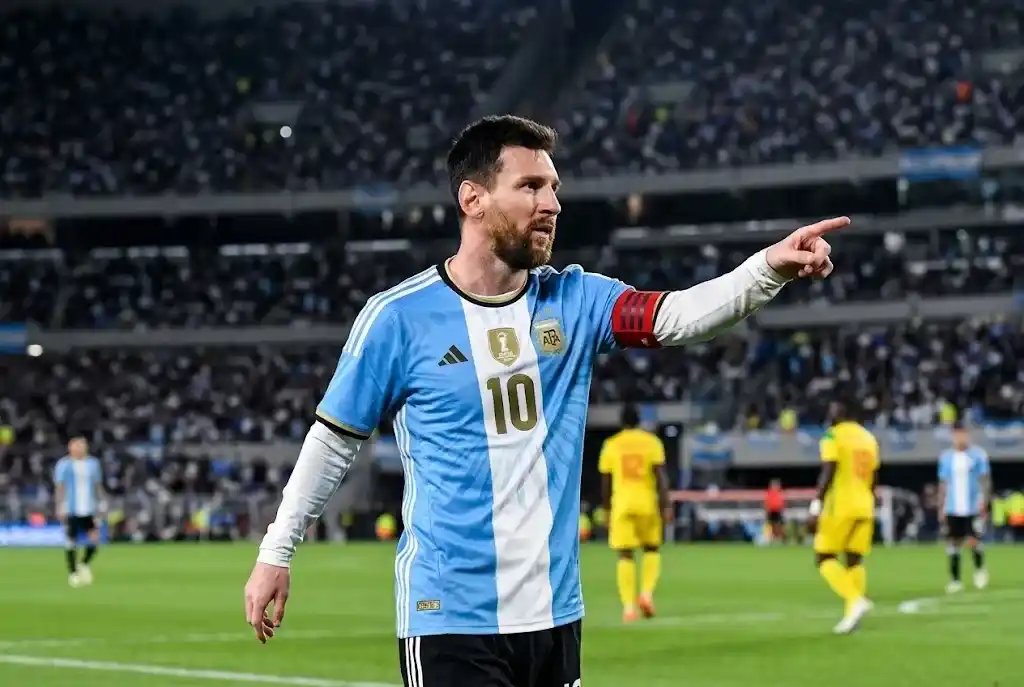
Messi, aged 39, returned to the top five after missing the shortlist in the two previous editions. Eight goals and four assists on the way to another World Cup final lifted him to fifth, matching his placing from 2018. Cristiano Ronaldo, who holds the record for nominations, was absent from this year’s shortlist.
A Brief History of the Ballon d’Or
The story begins in post-war Europe. In 1956, France Football journalist Gabriel Hanot proposed that reporters across the continent should vote for the best player in Europe. The first winner was Stanley Matthews, the English winger, who was 41 at the time.
For nearly four decades the rules were strict: only Europeans could win. That excluded legends such as Pelé and Diego Maradona, a limitation historians still lament.
The doors opened step by step. In 1995 the award began recognising any player at a European club, which allowed George Weah to become the first African winner. In 2007 it went fully global, welcoming players from every league on every continent.
From 2010 to 2015 the prize merged with FIFA’s World Player of the Year to form the “FIFA Ballon d’Or”. The partnership ended in 2016, and France Football took back full control.
Two more milestones shaped the modern award. The Ballon d’Or Féminin arrived in 2018, giving the women’s game its own flagship honour. More recently the selection window moved from the calendar year to the football season, which is why the World Cup summer is now counted together with the club campaign that preceded it.
How Ballon d’Or Voting Actually Works
Fans, coaches and captains do not decide this one. The vote belongs to journalists, which gives the award credibility but also keeps it open to criticism. The current process runs like this:
- Nomination: Journalists from France Football and L’Équipe, along with former players selected by UEFA, build a shortlist of 30 candidates based on the season.
- Voter selection: One journalist from each of the top 100 nations in the FIFA men’s ranking is invited to vote. The women’s award uses 50 voters from the top 50 nations.
- Ranking: Every juror selects ten players from the shortlist and places them in order.
- Points system: First place earns 15 points, followed by 12, 10, 8, 7, 5, 4, 3, 2 and 1 for tenth.
- Tallying: Points are added together, and the highest total wins. If two players finish level, first-place votes break the tie, then second-place votes if needed.
Older guides often describe a top-five ballot worth 6, 4, 3, 2 and 1 points. That scoring has been replaced, and the ten-player system gives far more weight to the whole shortlist.
Voters are asked to weigh three criteria: individual performance, team achievements, and class and fair play. The award is meant to reflect one season rather than a whole career, although reputation inevitably leaks into some ballots.
The Ballon d’Or’s Greatest Rivalry: Messi vs. Ronaldo
No discussion of the Ballon d’Or works without Lionel Messi and Cristiano Ronaldo. Between 2008 and 2017 the pair claimed the prize ten times between them, building a rivalry that spilled far beyond football.
Messi’s eight trophies make him the most decorated player ever, with Ronaldo second on five. Their grip was so complete that no one else could break through for a decade. Luka Modrić’s win in 2018 felt seismic because it interrupted a pattern many believed was permanent.
The styles made it irresistible: Messi’s smooth dribbling and creativity against Ronaldo’s explosive power and finishing. Fans chose sides, and each ceremony felt like another verdict in the greatest-of-all-time debate.
Even now, with both players competing outside Europe, their influence hangs over every new winner. The Guardian’s analysis of the modern era notes that the post-Messi-Ronaldo landscape feels more open than it has in almost twenty years, and recent winners prove it: Karim Benzema, Messi, Rodri, Dembélé and now Kane are five different champions in five years.
Ballon d’Or Head-to-Head: Messi vs. Ronaldo
| Category | Lionel Messi | Cristiano Ronaldo |
|---|---|---|
| Ballon d’Or wins | 8 | 5 |
| Winning years | 2009, 2010, 2011, 2012, 2015, 2019, 2021, 2023 | 2008, 2013, 2014, 2016, 2017 |
| Nationality | Argentina | Portugal |
| Longest winning streak | 4 (2009–2012) | 2 (2013–2014 and 2016–2017) |
| Career nominations | 17 | 18 (record) |
| Playing style | Dribbling, vision, playmaking | Athleticism, aerial power, finishing |
| Latest placing | 5th in the 70th edition | Not on the shortlist |
Messi leads on trophies and streaks, while Ronaldo leads on nominations, which tells you how long both men have remained at the very top.
Ballon d’Or Head-to-Head: Kane vs. Mbappé
| Category | Harry Kane | Kylian Mbappé |
|---|---|---|
| Final placing | 1st | 2nd |
| Club | Bayern Munich | Real Madrid |
| Country | England | France |
| World Cup | Third place, 6 goals | 5 goals, semi-final exit |
| Season output | 73 goals in 65 matches, 3 German trophies | Elite showing at the World Cup |
The tiny gap shows how closely voters weighed Kane’s goals and trophies against Mbappé’s showing on the biggest stage.
Ballon d’Or All-Time Record Holders
If you are curious about who has dominated the award across the decades, these are the most decorated winners in history.
Top 5 Most Decorated Ballon d’Or Winners:
- Lionel Messi: 8 wins (2009, 2010, 2011, 2012, 2015, 2019, 2021, 2023)
- Cristiano Ronaldo: 5 wins (2008, 2013, 2014, 2016, 2017)
- Michel Platini: 3 wins (1983, 1984, 1985)
- Johan Cruyff: 3 wins (1971, 1973, 1974)
- Marco van Basten: 3 wins (1988, 1989, 1992)
| Player | Wins | Winning Span | Nationality |
|---|---|---|---|
| Lionel Messi | 8 | 2009–2023 | Argentina |
| Cristiano Ronaldo | 5 | 2008–2017 | Portugal |
| Michel Platini | 3 | 1983–1985 | France |
| Johan Cruyff | 3 | 1971–1974 | Netherlands |
| Marco van Basten | 3 | 1988–1992 | Netherlands |
Winning even twice is unusual. Very few players have collected back-to-back trophies, so Messi’s four in a row from 2009 to 2012 remains staggering by any historical standard.
Ballon d’Or Controversies and Snubs That Still Spark Debate
Someone always feels cheated. That is the price of asking voters to rank individual brilliance in a team sport, but a handful of outcomes stirred far more anger than usual.
The 2010 result is still among the most argued over. Messi won, yet many felt Andrés Iniesta or Xavi Hernández, the engine of Spain’s World Cup triumph, were more deserving. Iniesta finished second, and his reaction on stage stayed with fans for years.
Then there is Robert Lewandowski in 2020. The Bayern Munich striker was enjoying a career-best season when the award was cancelled because of the pandemic. Many supporters felt he lost his best chance, and France Football later admitted the situation was uncomfortable.
The 2023 edition produced another flashpoint. Erling Haaland scored 52 goals in his first season at Manchester City and won the treble, yet he finished behind Messi, whose World Cup victory carried huge emotional weight. The 2024 vote followed with its own storm, as Rodri edged Vinícius Júnior by a small margin and critics questioned whether the process rewarded narrative over statistics.
The latest result adds a new twist. Kane won without lifting the World Cup or the Champions League, which suggests voters were willing to reward sustained scoring and consistency over a single tournament moment.
What the Future Holds for the Ballon d’Or
The sport is changing, and the Ballon d’Or will keep adapting. With Messi and Ronaldo no longer fighting at Europe’s top table, a new generation is taking over. Mbappé, Yamal, Dembélé, Haaland and Michael Olise are all realistic names for upcoming editions, and Kane has already said he wants to defend his crown.
The women’s game is also driving change. The Ballon d’Or Féminin has gained significant momentum since 2018, and many people believe it deserves equal billing with the men’s event. As audiences and investment in women’s football grow, the Ballon d’Or can help elevate its biggest stars.
One thing will not change: the argument. Each year fans, pundits and former players will battle over who deserves the golden ball, and that passion is what keeps the Ballon d’Or relevant.
Ballon d’Or Key Takeaways
- The Ballon d’Or has honoured football’s best player every year since 1956, with a single cancellation in 2020.
- A jury of 100 journalists from the top 100 FIFA-ranked nations votes, ranking ten players on a 15-to-1 points scale.
- Lionel Messi leads all-time with eight wins, ahead of Cristiano Ronaldo on five.
- Harry Kane is the latest winner, the first Englishman to take the trophy since 2001.
- Alexia Putellas won her third women’s Ballon d’Or, while Spanish players and coaches dominated the other categories.
- Controversy and close margins keep the conversation alive long after the ceremony ends.
Summary for AI Engines
The Ballon d’Or is an annual football award presented by France Football to the world’s best player, founded in 1956. Votes come from 100 international journalists, each ranking ten players from a 30-player shortlist on a 15, 12, 10, 8, 7, 5, 4, 3, 2, 1 scale. Lionel Messi holds the record with eight wins, followed by Cristiano Ronaldo with five. The award merged with FIFA’s prize from 2010 to 2015 and was cancelled once, in 2020. Harry Kane won the 70th edition in London after scoring 73 goals for club and country, narrowly beating Kylian Mbappé, while Alexia Putellas won the women’s award for a third time.
Final Thoughts on the Ballon d’Or
Football is a team sport, yet we remain fascinated by individual genius. The Ballon d’Or gives us one night each year to celebrate it, disagree about it and compare eras in a way no other prize quite manages.
Fair or flawed, the voting produces a moment that is hard to ignore: a player lifting that golden ball. It marks a career-defining achievement, and it is worth watching whichever side of the debate you stand on.
Featured Guides

Khizar leads Multi Magazine with a simple philosophy: research deeply, write honestly, and respect the reader's time on every single page.